Built by T1Ds · For T1Ds

Diabetes Education for How People Actually Learn.

Beta Cell Foundation creates scaffolded diabetes education — structured programs, interactive tools, and community experiences that build real self-management skills.

What we build

Programs That Build Real Skills.

BCF education reaches people through structured programs and community experiences that reinforce each other.

Who we are

Built by T1Ds. For T1Ds.

Beta Cell Foundation was built by people who live with type 1 diabetes and wanted to give back to the community in the way they wish someone had given back to them — not with another article, but with education that actually changes what you're capable of.

100%
T1D
Built & run by people with T1D
Free
Every Program
Print & online, always
501c3
Nonprofit
EIN 84-4054715
Our approach

Scaffolded. Active. Built for Your Body.

BCF applies evidence-based learning principles to diabetes education — designed to develop genuine capability, not just deliver information.

Learning Design
Scaffolded Sequences
Concepts build on each other — the same way you'd learn any complex skill. No concept is introduced before you have the foundation to use it.
Active Learning
Practice, Not Just Information
Log your own data, use interactive tools, set goals, and reflect — because reading about management isn't the same as doing it.
Personalized
Your Body. Your Patterns.
Every body is different. Our programs give you frameworks to understand your own — not protocols designed for someone else.
Stay updated

New Programs. New Events. Be the First to Know.

Sign up for the BCF newsletter to hear when new education programs, tools, and community events launch.

Help Us Build More.

Every BCF program is free. Building them takes time, expertise, and resources. If you believe the T1D community deserves education that actually works, consider supporting the people building it.

Education Hub

Skills-Based Diabetes Education.

Every BCF education program applies evidence-based learning principles — scaffolded concepts, active practice, reflection — to build genuine capability, not just deliver information.

What Makes This Different

Learning Design
Scaffolded Sequences
Concepts build on each other in a specific order — nothing is introduced before you have the foundation to use it.
Active Learning
Practice, Not Just Information
Log your own data, use interactive tools, set goals, and reflect — because reading about management isn't doing it.
Personalized
Your Body. Your Patterns.
Every body is different. Our programs give you frameworks to understand your own — not protocols designed for someone else.

Available Programs

Coming Soon · Structured Program · Free
Diabetes & Exercise Workbook

The most complete T1D exercise education program available. Learn to track your own blood sugar patterns during physical activity, find what's driving them, and build a management strategy that actually works for your body and your workouts.

This is a structured education program — not a collection of tips. Designed using scaffolded learning principles so every concept builds on the one before. The workbook includes a self-assessment, a foundations section on how insulin and exercise interact, log pages designed to capture everything relevant to each workout, pattern-finding frameworks, and goal-setting prompts to translate insight into action.

This workbook is in final development and will be available soon. It will always be free — as a PDF download and online.
What you'll be able to do
  • Understand insulin on board during exercise — and use that understanding in real time, not just in theory
  • Identify aerobic vs. anaerobic blood sugar responses — and adjust your strategy based on what type of activity you're doing
  • Build a fueling strategy — that prevents both mid-workout lows and post-workout highs, for your specific body
  • Apply consistent tracking — a system that lets you find patterns across weeks and months of exercise data
Free · Interactive Tool · Available Now
Blood Sugar Simulators

Visualize exactly how insulin behaves in your body — timing, peak, duration, and how exercise and meals change everything. Seven interactive simulators covering bolus timing, split bolus, temp basals, exercise timing, extended exercise, high-intensity exercise, and a full 24-hour model.

These are interactive models you control — designed to help you see the relationships that are otherwise invisible.

Open Blood Sugar Simulators

In Development
More Programs Coming

We're building programs to cover every major aspect of living with T1D. Each one follows the same structure: scaffolded concepts, active learning tools, print and online availability.

  • Nutrition — Fat, protein, glycemic index, and what they mean for your management beyond carb counting
  • Hormonal Changes Through Life — How puberty, menstrual cycles, menopause, and aging affect insulin needs and blood sugar patterns
  • Materials for Healthcare Providers — Tools to help clinicians teach diabetes management more effectively in medical care settings
  • Talking to Your HCPs — Tools and frameworks for getting the most out of your doctor's appointments and advocating for your care
  • Virtual Accountability Groups — Structured peer learning groups that meet regularly to share progress, strategies, and support

Help Us Build More Programs.

Every BCF education program is free. Building them takes time, expertise, and resources. Your support helps us develop the next workbook, the next simulator, the next tool that changes how people manage T1D.

Blood Sugar Simulators

Visualize How Insulin Works

Interactive tools to help people with diabetes understand how insulin, food, and exercise interact to affect blood glucose.

For educational purposes only. These simulators are visual learning tools — not medical devices or dosing calculators. They show relative effects, not actual blood sugar numbers. Talk to your care team before making any changes to your insulin or exercise routine.

Keep These Tools Free.

The Blood Sugar Simulators are free for everyone — no account, no paywall, no ads. Building and maintaining them takes real resources. If these tools have helped you, consider supporting the team behind them.

Bolus Timing Simulator

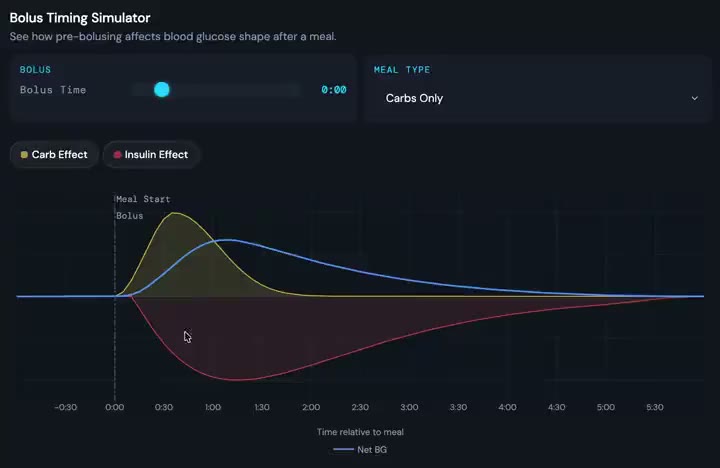
Move the slider to see how insulin timing relative to meal start affects blood glucose.

When you eat, your blood sugar rises. When you take insulin, your blood sugar falls. That sounds simple, but timing of insulin in relation to eating impacts how blood sugars change during that process.

This chart is designed to help you visualize how insulin absorption and food digestion overlap over time with carbs or high fat meals. By adjusting when insulin is given relative to when food is eaten, you can see how different timing strategies may change the shape of your blood sugar curve.

Pay attention to:

For educational purposes only. This simulator is a visual learning tool — not a medical device or dosing calculator.

What's happening here?

Fast-acting insulin starts working about 10 minutes after injection, peaks around 60-90 minutes, and stays active for up to 6 hours. It does not follow a sharp on/off curve — it ramps up slowly, reaches a peak, then tapers off gradually.

Food digests at a different rate than insulin works. Carbohydrates raise blood sugar faster than insulin can pull it down. Fat and protein slow that absorption considerably.

When you bolus early (pre-bolus)

  • Insulin begins working before carbs are digested, which can blunt or prevent the post-meal spike
  • Bolusing too far ahead can cause blood sugar to drop before food absorbs, especially with lower-carb or mixed meals
  • Pre-bolusing works best with fast-digesting, carbohydrate-heavy meals

When you bolus late or at meal start

  • Carbs absorb while insulin is still ramping up, which often causes a spike before insulin brings it back down
  • For high-fat meals, a later bolus may better match the slower digestion curve
  • A late bolus rarely causes the same early low risk as a pre-bolus does

Applying this to your own life

Track what happens with different bolus timing for the meals you eat most often. A CGM makes this easy — look at the curve 1-3 hours after eating. Over time, you will develop a feel for how much lead time each type of meal needs.

Keep notes on:

  • Which meals benefit from a 15-30 minute pre-bolus
  • Which meals cause an early drop when pre-bolused
  • How the curve differs between carb-heavy and high-fat meals

Split Bolus Simulator

See how splitting your dose across two injections — or using an extended bolus on a pump — can improve coverage for high-fat and mixed meals.

A split bolus divides your total insulin dose into two parts delivered at different times. The goal is to better match how insulin acts to how food absorbs — especially for high-fat meals that digest slowly and raise blood sugar over several hours rather than all at once.

MDI users (injections) do this by giving two separate injections: one at meal start and a second 60-90 minutes later. Pump users achieve the same result with an extended bolus: an immediate upfront portion delivered all at once, followed by the remainder spread evenly over a set duration in small pulses every few minutes. The effect on blood sugar is nearly identical — the difference is just in how the second portion is delivered.

Pay attention to:

For educational purposes only. This simulator is a visual learning tool — not a medical device or dosing calculator.

What's happening here?

Fast-acting insulin peaks around 60-90 minutes after injection. A single upfront dose concentrates most of its action in the first two hours. For a high-fat meal that absorbs over 4-6 hours, this creates a mismatch: insulin acts early, food absorbs late — resulting in an early drop followed by a late rise.

Splitting the dose spreads insulin action across a longer window, better matching that slower absorption curve.

For carbohydrate-heavy meals

  • A single dose given 15-30 minutes before eating usually provides good coverage
  • Splitting is usually not necessary and can add complexity without benefit
  • A well-timed pre-bolus often outperforms a split for fast-absorbing meals

For high-fat or mixed meals

  • Fat slows digestion, so a large upfront dose can cause an early low before food absorbs
  • Giving part of the dose upfront and the rest 60-90 minutes later — or spread over 1.5-3 hours on a pump — can better follow the slower rise
  • A common starting point is 50-60% upfront with the remainder delayed or extended

MDI vs. pump extended bolus

MDI: Give two separate injections — one at meal start, a second 60-90 minutes later when the food is clearly absorbing.

Pump extended bolus: The immediate portion is delivered like a normal bolus; the extended portion is dripped in automatically over your chosen duration in small pulses every few minutes.

The blood sugar effect is nearly identical — the pump just automates what MDI does manually, and allows finer control over the delivery window.

Applying this to your own life

Split and extended bolusing works best for meals where you consistently see a late rise — often 2-4 hours after eating — despite good early coverage. Pizza, pasta with cream sauce, and high-fat restaurant meals are common examples.

Keep notes on:

  • Which meals consistently cause a late rise even with a well-timed bolus
  • Whether delaying part of the dose reduces that late rise
  • For pump users: whether a 1.5-3 hour extended duration smooths the curve better than a single second injection would
  • How the split percentage affects the shape of the curve for your specific meals

Temp Basal Simulator

For pump users: see how adjusting your basal rate around exercise affects blood glucose.

Insulin pumps deliver basal insulin as small, continuous pulses of fast-acting insulin. A temporary basal rate lets you reduce or increase this delivery for a set period of time.

This chart is designed to help you visualize how adjusting your basal rate before, during, and after exercise changes insulin delivery and blood glucose — especially when combined with food and the glucose-lowering effect of exercise itself.

Pay attention to:

For educational purposes only. This simulator is a visual learning tool — not a medical device or dosing calculator.

What's happening here?

Insulin pumps deliver basal insulin as rapid micro-pulses of fast-acting insulin, unlike MDI users who inject a slow-acting basal insulin once or twice a day. This means pump basal can be adjusted in real time — increased, decreased, or suspended — to respond to changing circumstances like exercise.

A temporary basal rate reduces or increases this ongoing delivery for a set period. Because each micro-pulse of fast-acting insulin has the same absorption curve as a bolus, the timing of the rate change matters as much as the magnitude.

Why timing matters

  • Fast-acting insulin from a temp basal change takes 15-30 minutes to start reducing delivery and 60-90 minutes to reach peak impact
  • Setting a temp basal at the start of exercise is often too late — the insulin from the minutes just before exercise is already absorbed and active
  • Starting a reduced basal 60-90 minutes before exercise gives the change time to take effect before activity begins

What happens when basal is reduced

  • Less fast-acting insulin is delivered over time, so the ongoing pull on blood sugar decreases
  • Blood sugar tends to drift upward if basal is reduced for long enough
  • The exercise-driven glucose uptake partially offsets this rise, but the balance is different for every individual

What happens after exercise

  • Returning to normal basal while insulin sensitivity is still elevated can cause a drop
  • Some people maintain a reduced basal for 1-2 hours after finishing to account for lingering sensitivity
  • Food eaten post-workout will also have a smaller insulin requirement than usual

Applying this to your own life

Temp basals require experimentation. Start with a modest reduction (50-70%) beginning 60-90 minutes before exercise, and track what happens to blood sugar during and after.

Keep notes on:

  • What time before exercise you set the temp basal and how blood sugar responded
  • Whether the exercise-driven drop was blunted, eliminated, or whether you went high instead
  • How long after exercise your blood sugar continued to trend down, and whether a reduced basal post-workout helped

Exercise Timing Simulator

For aerobic and low-to-moderate intensity exercise: see how food and insulin timing interact with the glucose-lowering effects of a workout.

Exercise causes muscles to absorb glucose directly — with or without insulin. That means blood sugar can drop during a workout even if you have no insulin on board. When you do have insulin active, exercise amplifies its effect.

This chart is designed to help you visualize how the timing of food and insulin around exercise changes the blood sugar curve before, during, and after a workout.

Pay attention to:

For educational purposes only. This simulator is a visual learning tool — not a medical device or dosing calculator.

What's happening here?

During aerobic exercise, your muscles can absorb glucose without insulin — a direct, insulin-independent uptake that causes blood sugar to drop regardless of how much insulin is on board. The harder and longer you exercise, the more pronounced this effect.

When you also have insulin active during exercise, the two effects compound. Exercise accelerates insulin absorption from the injection site, meaning insulin peaks sooner and acts more strongly than it would at rest. This combination — glucose uptake by muscle plus faster-acting insulin — can cause a rapid drop.

Before exercise

  • A large bolus 1-2 hours before a workout will still be near its peak when exercise starts, compounding the glucose drop
  • Eating carbs without a bolus can raise blood sugar before exercise, which then acts as a buffer against the exercise-driven drop
  • Starting exercise with no insulin on board and no food means blood sugar may drop from muscle uptake alone

During exercise

  • Blood sugar typically falls throughout the workout, faster if insulin is active
  • Fueling with fast-acting carbs during the workout can offset the drop
  • The rate of drop depends heavily on how much insulin was taken before and when

After exercise

  • Insulin sensitivity remains elevated for hours after a workout — sometimes up to 24 hours
  • The same dose of insulin lowers blood sugar more than it would at rest
  • Meals and corrections in the hours after exercise often need to be smaller than usual

Applying this to your own life

Watch what happens to your blood sugar in the 2-3 hours before, during, and after workouts. The patterns repeat, but they depend on how much insulin is on board when you start.

Keep notes on:

  • What your blood sugar does during different types of workouts
  • Whether pre-workout carbs help keep blood sugar stable, and how much
  • Whether you notice lows 2-6 hours after exercising — this is the elevated sensitivity window

Extended Exercise Simulator

Model blood glucose across a 4-hour workout: pre-exercise preparation, in-exercise fueling, and post-workout recovery.

Long workouts lasting four or more hours deplete glycogen stores, increase insulin sensitivity, and require active fueling strategies to maintain blood glucose. The effects extend well beyond the exercise window itself.

This chart is designed to help you visualize how pre-exercise fueling, in-exercise nutrition, pump temp basals, and post-exercise recovery all interact across the full timeline of a long workout.

Pay attention to:

For educational purposes only. This simulator is a visual learning tool — not a medical device or dosing calculator.

What's happening here?

Extended exercise changes how both insulin and carbohydrates behave in your body. Muscles run primarily on glycogen — a form of glucose stored in muscle tissue and the liver. At sustained effort, your body burns through that glycogen steadily, and stores typically last around 90-120 minutes before they start running low. Once glycogen is depleted, performance drops sharply and blood sugar becomes harder to maintain.

This is why fueling during long workouts isn't optional — it's not just about managing blood sugar, it's about keeping your muscles supplied with the energy they need to keep going. The good news: during aerobic exercise, working muscles can pull glucose directly from the blood without needing insulin to do it. That means carbs you eat during the workout go largely straight to the muscles, so you need far less insulin to cover in-exercise fueling than you would for the same amount of carbs eaten at rest.

Important — insulin does more than lower blood sugar: Most people only think about insulin when blood sugar is high, but your body needs insulin continuously — even when blood glucose is normal. Every cell in your body uses glucose as fuel, but glucose can't get into cells without insulin acting as a "key" to unlock the door. Without it, cells are forced to burn fat for energy instead, producing acidic byproducts called ketones. If ketones build up faster than the body can clear them, the blood becomes dangerously acidic — this is diabetic ketoacidosis (DKA). DKA is caused by a lack of insulin, not by high blood sugar, and it can develop even when blood glucose looks normal. For pump users especially, suspending insulin for more than a few hours removes all background coverage and creates real DKA risk.
Phase 1
Before Exercise

Fueling before a long workout tops off glycogen stores. Carbohydrates are stored as glycogen in muscles and the liver — once those stores run out, performance drops and blood sugar becomes harder to control.

Phase 2
During Exercise

Working muscles absorb glucose directly without needing insulin. This means less insulin is required to cover in-exercise carbs, and any insulin already on board has a much stronger effect than usual.

Phase 3
After Exercise

Muscles and liver continue pulling glucose to replenish depleted glycogen. Increased insulin sensitivity can last many hours — sometimes up to 24 hours.

During exercise (4 hours)

  • The same amount of insulin lowers blood sugar more than usual.
  • If fueling is too low, blood sugar may drop steadily throughout the workout.
  • If fueling matches muscle demand and insulin is appropriately adjusted, blood sugar may stay stable.

After exercise (post-workout)

  • Blood sugars trending lower in the hours after finishing.
  • Reduced insulin needs for meals eaten after exercise.
  • Increased risk of delayed lows, especially overnight.

The day after

  • Muscles and liver continue restocking glycogen for 24-48 hours, pulling glucose out of the bloodstream even when you're at rest.
  • Insulin sensitivity may remain elevated the next morning — breakfast and correction doses can hit harder than usual.
  • Overnight lows are most common after a long afternoon or evening workout when dinner insulin and the post-exercise effect overlap.
  • A small bedtime snack or reduced overnight basal can help bridge the gap between the post-exercise effect and waking up in range.

MDI vs Pump

MDI users rely on long-acting basal insulin, which cannot be adjusted quickly. Pump users can adjust basal rates, but changes take time due to absorption. This is why temp basal reductions often need to start 90-120 minutes before exercise begins.

Applying this to your own life

Extended workouts require planning in three phases:

  • Before: Evaluate insulin on board, adjust pump basal early if needed, fuel to support glycogen stores.
  • During: Fuel regularly, monitor trends, remember less insulin is needed but not zero insulin.
  • After: Expect increased insulin sensitivity, consider reduced bolus doses, watch for delayed lows especially overnight.

High-Intensity Exercise Simulator

See how sprints, heavy lifts, and interval training create a different blood glucose pattern than moderate exercise.

High-intensity exercise above roughly 85% of your maximum heart rate triggers a stress response that temporarily raises blood sugar — even while you are burning fuel at a very high rate. This makes it one of the most counterintuitive situations in diabetes management.

This chart is designed to help you visualize how blood glucose, insulin on board, and insulin sensitivity interact during and after a short, intense workout.

Pay attention to:

For educational purposes only. This simulator is a visual learning tool — not a medical device or dosing calculator.

What's happening here?

During high-intensity exercise, your body releases stress hormones — primarily adrenaline and cortisol — that signal your liver to release stored glucose rapidly. This release outpaces how fast your muscles can use it, so blood sugar rises even though you are working hard.

Unlike moderate exercise, which typically lowers blood sugar during the workout, high-intensity effort can push blood sugar up significantly. The rise often peaks 5-15 minutes after the hardest effort ends, not during it.

Important: The post-workout high is temporary. Giving a large correction bolus during this window can cause a significant low 1-3 hours later as insulin sensitivity spikes during recovery.
Phase 1
During Effort

Stress hormones cause the liver to release glucose faster than muscles can absorb it. Insulin on board is temporarily less effective. Blood sugar rises.

Phase 2
Early Recovery

Stress hormones clear. Blood sugar peaks and begins falling. Insulin on board starts working more effectively — sometimes more than expected.

Phase 3
Late Recovery

Depleted muscles pull glucose from the blood to replenish stores. Insulin sensitivity is significantly elevated. The risk of a delayed low is highest here.

During the workout

  • Stress hormones cause the liver to release glucose faster than muscles can absorb it
  • Insulin on board is less effective than usual — your body is temporarily more resistant to insulin during peak effort
  • Subcutaneous insulin may absorb slightly slower during peak effort due to reduced skin blood flow

Immediately after (0-60 minutes)

  • Stress hormones begin to clear, and blood sugar starts falling from its peak
  • Insulin on board begins working more effectively as resistance fades
  • Any correction bolus given for the post-workout high will act faster and stronger than it would at rest

Later after (1-6 hours)

  • Muscles that were depleted during the workout begin pulling glucose to replenish their stores — with or without insulin
  • Insulin sensitivity is significantly elevated, meaning the same dose lowers blood sugar much more than usual
  • This is the window where a correction given for the earlier high can cause a significant low

The day after

  • Insulin sensitivity can remain elevated for up to 24-48 hours after intense exercise
  • Meals and corrections during this window may need smaller doses than usual

Applying this to your own life

High-intensity workouts create two separate management challenges that happen back to back: a high during and just after the effort, followed by an elevated low risk in the hours that follow.

When doing intense workouts, watch how your blood sugar responds during the workout itself and for several hours afterward. A CGM is especially useful here because the delayed low can happen well after the workout feels finished.

As you make observations, keep notes on:

  • How high your blood sugar rises and how long the peak lasts after you finish
  • How quickly it falls in the first hour after you stop
  • Whether you notice lows 2-6 hours later, and whether they happen during sleep if you worked out in the evening
  • How your next meal's insulin needs compare to a day when you didn't work out

24-Hour Diabetes Simulator

See how food, insulin, and exercise interact across an entire day — and how decisions made in the morning shape what happens at night.

Every simulator on this site isolates one variable at a time — a single bolus, one workout, a temp basal change. In real life, all of those things happen on the same day, and the effects compound in ways that aren't always intuitive. A workout at noon changes how your evening meal behaves. A temp basal set hours before exercise still has insulin on board during it. Multiple workouts mean glycogen depletion carries forward from one session to the next.

This simulator lets you build an entire day from scratch using the same underlying math as all the other simulators. Add boluses, meals, exercise sessions, and (if using a pump) temp basals at any time in the 24-hour window. The effects stack and compound exactly as they would in your body.

New here? If the chart looks overwhelming, start with the individual simulators to learn each effect in isolation — then come back here to practice combining them.

Pay attention to:

For educational purposes only. This simulator is a visual learning tool — not a medical device or dosing calculator.

What's happening here?

The chart shows blood glucose effects across a full 24-hour day, from your selected wake time back to the same wake time the next day. The darker shaded region is your sleep window. The chart starts flat — all the BG change you see comes from entries you add.

Dawn phenomenon

Starting at wake time, cortisol and growth hormone naturally drive the liver to release glucose — a phenomenon called the dawn effect. In people with type 1 diabetes, there is no automatic compensating insulin response, so BG rises predictably each morning. The size of the rise varies by person, but it is nearly universal. Most people need to account for this with a morning bolus or, on a pump, a higher pre-dawn basal rate.

Compounding exercise effects

When you exercise more than once in a day, the effects stack. The post-exercise sensitivity from your first session may still be active when your second workout begins. More importantly, glycogen stores depleted during the first workout have to be replenished through food before the next session — otherwise your muscles are drawing from an already-depleted reserve, making the blood sugar drop during exercise larger and faster than expected.

Overnight insulin sensitivity

Research consistently shows that moderate-to-heavy exercise increases insulin sensitivity for 12-24 hours afterward, including during sleep. For people on insulin, this means the same basal rate that kept blood sugar stable the night before a workout day may cause low blood sugar the night after. The effect is proportional to how much you exercised — a light 30-minute walk has minimal effect, while a hard hour-long run or a long bike ride can meaningfully shift overnight sensitivity.

MDI vs Pump

MDI users have long-acting basal insulin that cannot be adjusted once injected — the only tools are timing and amount of fast-acting doses, and food. Pump users can add temp basals at any point to adjust delivery up or down, giving more flexibility around exercise, meals, and overnight patterns.

Applying this to your own life

The goal of the individual simulators is to help you understand each effect in isolation. The goal of this one is to help you understand how they interact. Use them in that order.

  • Start with the individual simulators: Use Bolus Timing, Split Bolus, Exercise Timing, and the others to build intuition for each effect in isolation — then come back here to practice combining them. If you see something in the 24-hour chart you don't understand, open the specific simulator for that effect.
  • Match the simulator to your day: Think of a real day you've had — a workout, a meal that didn't go as expected, a late correction bolus — and try to recreate it here. See if the chart reflects what you actually experienced.
  • Keep notes: When you notice a pattern in your own data — lows on workout evenings, a stubborn high every morning — bring that question to the simulator. Try different combinations and see what the model suggests.
  • Try things you wouldn't try in real life: This is a simulation. Setting a temp basal two hours before exercise and seeing how it plays out costs nothing here. Build the intuition before you need it.

How These Simulators Work

Food, insulin, and exercise all operate at different speeds — and those change when they overlap. These tools make those invisible processes visible so you can learn to anticipate them.

What You're Looking At

Each chart shows relative effects — how a factor moves blood sugar compared to a flat baseline. No actual blood sugar numbers appear, because everyone's starting point is different. The shape of the curve is what matters: when it peaks, how long it lasts, and how it overlaps with other effects.

Not medical advice. These are learning tools, not management tools. Talk to your care team before making any changes to your insulin or exercise routine.

Each simulator is a sandbox for one concept. Start with the individual simulators to build intuition for each effect. When you're ready, the 24-Hour Simulator lets you combine everything and see how they interact across a full day.


What each toggle shows

The buttons above each chart let you show or hide individual effects. Here's what each one represents.

Carb Effect
Food raises blood sugar
Carbohydrates digest into glucose and enter the bloodstream. Fast-absorbing carbs (juice, glucose tablets) hit quickly. Complex carbs, fat, and protein slow the process down — which is why the same amount of food can produce very different curves depending on what's in it.
Insulin Effect
Insulin lowers blood sugar — slowly
Fast-acting insulin starts working about 10-15 minutes after injection, peaks around 60-90 minutes, and stays active for up to 6 hours. It never acts instantly. Where you are in that curve when you eat or exercise changes everything.
Basal Effect
Background insulin rate (pump only)
Insulin pumps run a continuous background dose all day. A temp basal change — higher or lower — takes 60-90 minutes to reach full effect. What you see is how that change compares to your normal baseline rate.
Exercise Effect
Muscles pull glucose during a workout
During aerobic exercise, working muscles absorb glucose directly from your blood — without needing insulin to do it. Blood sugar drops during the workout, and the drop is faster if insulin is also active. Harder effort means faster glucose uptake.
Post-Ex Effect
Recovery pulls glucose for hours after
After a workout ends, your muscles and liver continue pulling glucose from the blood to replenish depleted stores. This can last up to 24 hours. It's the main reason meals after a hard workout often need less insulin than usual — and why overnight lows happen on workout days.
Dawn Effect
Morning hormones raise blood sugar every day
Each morning, cortisol and growth hormone signal your liver to release stored glucose to fuel the start of the day. In people without diabetes, the pancreas compensates automatically. Without that response, blood sugar rises predictably every morning — whether you eat or not.
Overnight Sensitivity
Exercise makes insulin more effective overnight
After significant exercise, your body becomes more sensitive to insulin during sleep — the same dose lowers blood sugar more than it normally would. The harder you worked that day, the stronger the effect. It's one of the most common causes of unexpected overnight lows on workout days.

The Four Main Drivers of Blood Sugar

Understanding what moves blood sugar — and how fast — is the foundation of everything in these simulators.

Insulin

Insulin is what lets your cells use glucose for energy. Fast-acting insulins — sold as Humalog (lispro), Novolog (aspart), and Fiasp (faster aspart) — take time to work and stay active for hours. Long-acting insulins — Lantus/Basaglar/Toujeo (glargine), Levemir (detemir), Tresiba (degludec) — provide a slow background throughout the day. Insulin pumps use only fast-acting insulin for both background and meal doses.

Your body needs some insulin at all times — not just when blood sugar is high. Without it, cells can't use glucose and begin burning fat instead, producing acidic byproducts called ketones. When ketones accumulate too fast, it becomes life-threatening (diabetic ketoacidosis, or DKA). DKA is caused by too little insulin, not high blood sugar — it can develop even when glucose looks normal, especially for pump users who suspend insulin for extended periods.

Carbohydrates

Carbohydrates raise blood sugar by converting to glucose during digestion. Speed depends on the type — pure sugars absorb in minutes, complex carbs take much longer. Fat and protein slow digestion, so a high-fat meal produces a very different curve than a bowl of rice with the same carb count. Fast-acting carbs (glucose tablets, juice) are the right tool for raising a low quickly — complex food is not.

Exercise

Exercise lowers blood sugar by allowing muscles to absorb glucose directly, without insulin. It also increases insulin sensitivity for hours afterward. High-intensity exercise works differently — stress hormones cause the liver to dump glucose, temporarily raising blood sugar during the effort before the drop comes later.

Your Liver

Your liver stores glucose as glycogen and can release it into the bloodstream when the body signals it to. Two different mechanisms trigger that signal. The first — stress hormones like adrenaline during intense exercise or cortisol during illness or anxiety — still works in T1D and is a major reason blood sugar can rise unexpectedly without any food or insulin changes. The second is glucagon, a hormone the pancreas releases specifically in response to low blood sugar, which prompts the liver to release glucose as a rescue. In people without T1D, this rescue works automatically. In T1D, beta cells are destroyed, disrupting the signal that triggers glucagon — so the automatic rescue from hypoglycemia is significantly impaired or absent, particularly in people who have had T1D for many years. This is one of the reasons low blood sugar in T1D often requires eating fast carbs, glucagon nasal spray, or an injection to treat, rather than the body correcting itself.

Community Running Program

Leave No Ones Behind.

A global running community for people with type 1 diabetes. Local groups, online community, a T1D-specific Couch-to-5K plan, and a podcast — because running alongside other T1Ds teaches you things no workbook can.

Why Community Matters

Exercise is one of the most complex diabetes management challenges — and the best way to learn it is alongside people who are figuring it out too. Type One Run exists because peer learning works. Members share what's working, what isn't, and how they've adapted — and everyone gets sharper because of it.


The Community

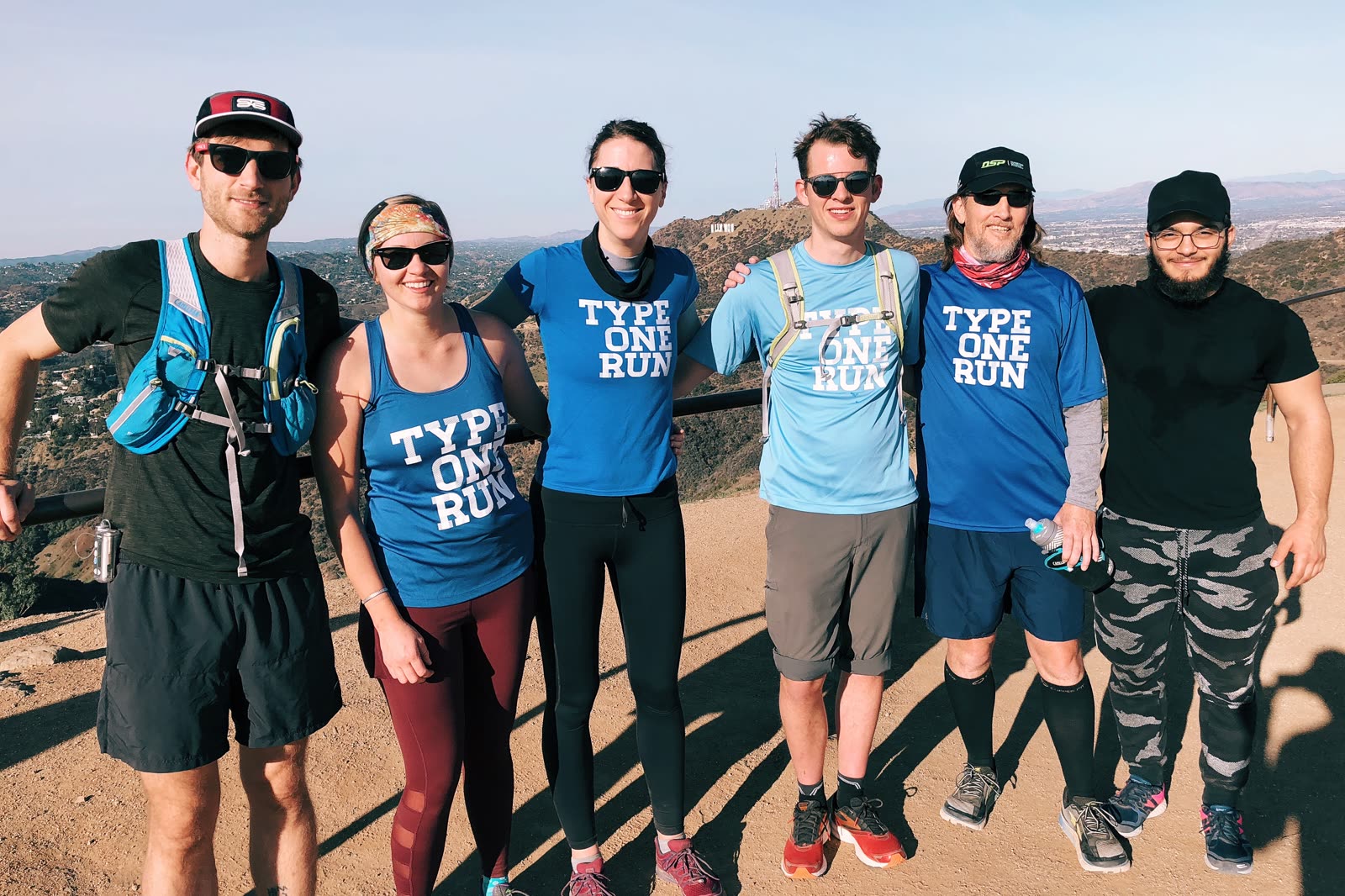
Type One Run began as a small running group in Los Angeles and grew into a global community because peer learning works. Members share what's working, what isn't, and how they've adapted — and everyone gets sharper because of it.

The community lives on Facebook, where T1D runners of all levels share strategies, race recaps, and real talk about running with diabetes. It's free, welcoming, and one of the most active T1D running communities anywhere.

5,300+
Members
Global community
Free
To Join
Always
Global
Reach
Local groups worldwide

Get Involved

  • Start a Local Group — Organize runs in your city. We provide marketing materials and support to help you get started.
  • Join an Existing Group — Find T1D runners near you through the Facebook community.
  • Run Virtually — Share your runs, ask questions, and connect with T1D runners worldwide.

Store & Marketing

Official Type One Run merchandise is available through the TOR store. Local group organizers can also access marketing materials — logos, social graphics, and print assets — to promote their chapters.


Type One Run Podcast

Real T1D runners sharing what running with diabetes actually looks like — what they've learned, what's failed, and how they've adapted. Hosted by Jon Foti, T1D and former Army helicopter pilot.

Help Keep This Community Running.

Type One Run is free — and always will be. Your support helps maintain the community infrastructure, produce the podcast, and keep programs like the Couch to 5K accessible to every T1D runner.

Outdoor Education Program

Live Wilder Lives, Together.

BCF-organized outdoor experiences — hiking, camping, and exploring — where the challenge of managing T1D in unpredictable real-world conditions becomes the best classroom there is.

Get Involved

Where the Real Learning Happens.

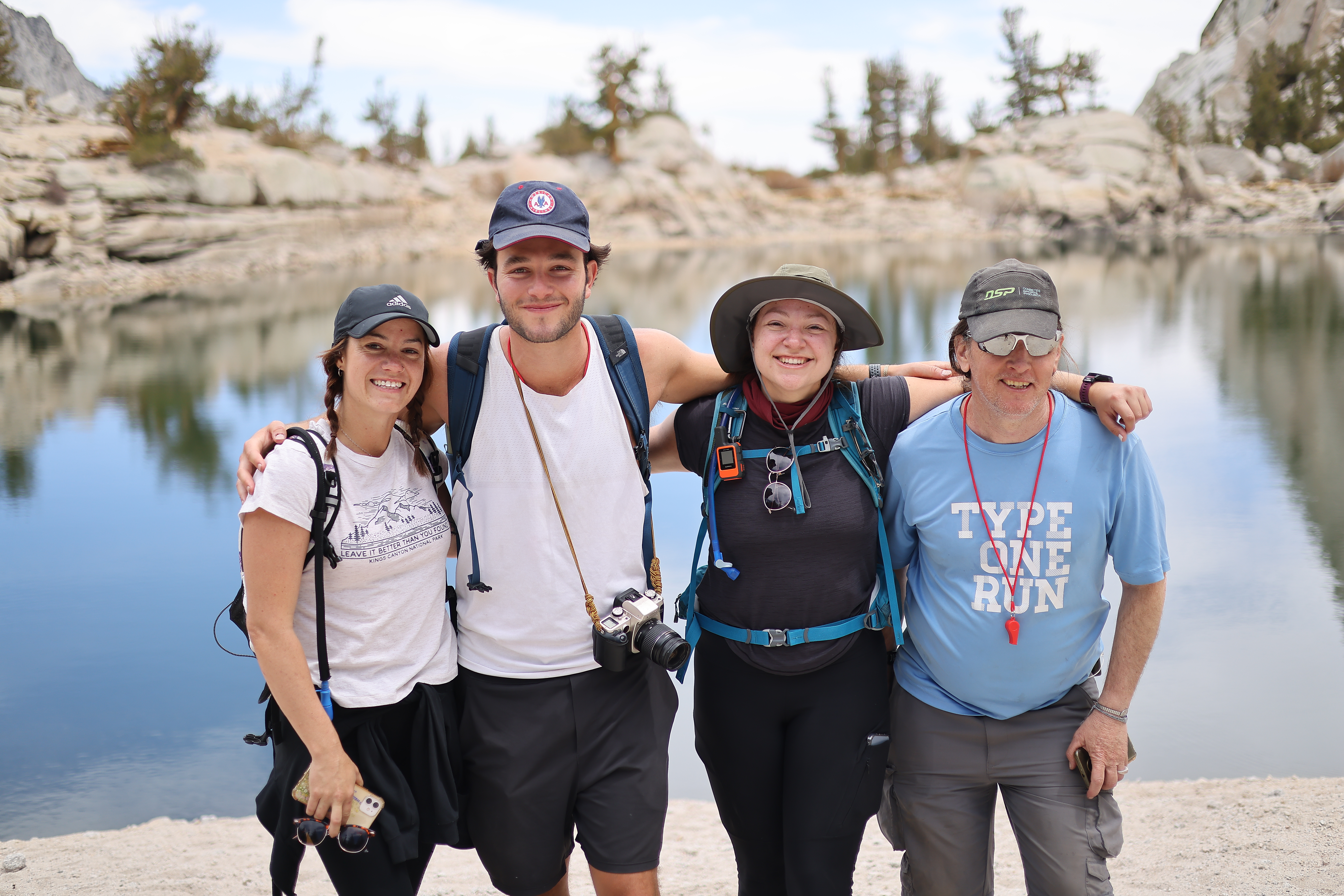
Something happens when a group of T1Ds faces the same challenge together in the real world. Someone's CGM dies on the trail. A blood sugar drops at altitude. The heat does something unexpected to insulin absorption. And in that moment, the group solves it together — drawing on everything they know, sharing what they've experienced, learning what no one else in the group had tried yet.

This is the kind of learning you can't get from a course or a video. It's embodied, contextual, and social. It builds confidence alongside knowledge — because you're not just learning what to do, you're proving to yourself that you can handle it.


What to Expect

  • Day Hikes — Group hikes on local trails, with real-time blood sugar management discussions along the way
  • Overnight Camping — Multi-day trips that add overnight management, meal planning, and gear logistics to the mix
  • Rock Climbing — Indoor and outdoor climbing that adds intensity management and adrenaline variables to the mix
  • Seasonal Events — Snowshoeing, paddling, and other seasonal activities that introduce new management challenges

What BCF Provides

Events are free or low-cost by design. Experienced T1Ds are always part of the group. You don't need to be an experienced hiker or have your diabetes perfectly managed — you need to want to be outside and willing to learn alongside others managing the same thing.

Real Conditions. Real Community. Real Learning. — Events are designed to be accessible to a range of fitness levels. The goal is learning through experience, not athletic achievement. If you can walk a trail, you can do a T1Ds in the Wild event.

Help Us Get More T1Ds Outside.

T1Ds in the Wild events are free or low-cost by design. Your support covers equipment, instruction, food, and logistics — so the only thing participants need to bring is their sense of adventure.

About BCF

We Built the Education We Needed.

Beta Cell Foundation is a 501(c)(3) nonprofit founded by people with type 1 diabetes who wanted to put something real back into the community — not awareness, not inspiration — education that actually builds skills.

Where This Came From

Beta Cell Foundation started with a simple observation: the knowledge that makes the biggest difference in day-to-day T1D management isn't in textbooks or clinical guidelines. It's in running groups, at diabetes camps, on trails, in online communities. It's the knowledge that flows between people who are managing this disease together in real life.

The question was how to take that knowledge — earned through years of trial and error, shared in fragments across a thousand conversations — and make it more structured, more accessible, and more powerful. How do you turn lived experience into education that actually teaches skills?

That's what BCF set out to build. Starting with Type One Run, a running community that became a proving ground for peer learning, and growing into a nonprofit that now develops full education programs, hosts structured community events, and builds interactive tools that help T1Ds understand their own physiology.

The education principles we apply aren't new. Scaffolded learning, active tools, reflection and goal-setting — these techniques have transformed learning in other fields. What's new is applying them to diabetes education, in a way that puts the learner — their specific body, their specific life — at the center.

Every program BCF creates starts with the same two questions: what skill does a person with T1D need, and what's the most effective way to teach it?


How We Think About Education

  • Skill requires more than information — it requires the right sequence, active practice, tools for the moment, and a way to reflect and refine. BCF designs every program around these principles.
  • Community is one of the most powerful educational contexts there is — when T1Ds learn together, in a running group, on a trail, or in an online community, knowledge flows in both directions. BCF builds programs that harness that.
  • Education should adapt to the learner, not the other way around — every body is different. Every life is different. Our programs give you frameworks to understand your own — not protocols designed for someone else.
  • Access isn't optional — every program in print and online. T1D doesn't care about your income, location, or circumstances — and neither does BCF.
  • Resilience is a learnable skill too — the confidence to manage a lifelong chronic disease, and the community to lean on when it gets harder, are built through the right experiences. BCF programs are designed to build both.

Who BCF Serves

Primary
People with T1D
At any stage — from newly diagnosed to decades in, looking to deepen their self-management skills. Our programs meet you where you are.
Also
Healthcare Providers
BCF is developing education to help clinicians teach diabetes management more effectively. Better-equipped providers mean better-supported patients.
Also
Caregivers & Family
People who want to understand what their person with T1D is experiencing and how to support them in building their own management skills.

Organization

Beta Cell Foundation is built and run by people with type 1 diabetes. Every person who works on BCF does so because they believe in what it's building. Our programs are free and always will be.

Structure
501(c)(3) Nonprofit
EIN 84-4054715. All donations are tax-deductible to the extent allowed by law.
Operations
100% T1D
Every program is built and run by people with type 1 diabetes who believe the T1D community deserves better education — and are willing to do something about it.
Access
Always Free
Every BCF program is free, in print and online. That's a commitment — it's core to what BCF is.

Get in Touch

Questions, partnership inquiries, press, or just want to connect — reach us by email.

Support what we're building. Every BCF program is free — building them takes time, expertise, and resources. Donate to BCF

Support What We're Building.

Every BCF program is free — building them takes time, expertise, and resources. If you believe the T1D community deserves education that actually works, consider supporting the people building it.

Support BCF

Support Diabetes Education That Actually Works.

Every BCF program is free. Building them takes time, expertise, and resources. If you believe people with T1D deserve education designed for how people actually learn — not just more information — this is how you help build it.


Where Your Support Goes

BCF is built and run by people with type 1 diabetes — developing skills-based T1D education that's available to everyone, free of charge.

  • Development of new education programs — the Diabetes & Exercise Workbook, and upcoming programs on travel, nutrition, CGM data interpretation, managing the emotional demands of T1D, and provider education
  • Blood Sugar Simulators — hosting, development, and ongoing refinement of the interactive tools
  • T1Ds in the Wild events — programming, logistics, and materials for BCF-organized community experiences
  • Infrastructure — the platforms and tools that keep everything online, accessible, and free for everyone
  • Print accessibility — making sure every program is available as a PDF that can be printed and used without a device or internet connection

Why It Matters

The T1D community deserves education that's built the way education researchers know actually works — scaffolded, active, tool-supported. Most diabetes education isn't. BCF is building what's missing.

Every program BCF creates will be free, in print and online, for every person with T1D — regardless of where they live, what device they have, or what they can afford. That's only possible because of people who believe in it and choose to support it.

Beta Cell Foundation is a 501(c)(3) nonprofit organization.
EIN: 84-4054715
All donations are tax-deductible to the extent allowed by law. You will receive a receipt by email.

Learn More About Who We Are.

Beta Cell Foundation was built by people with T1D who wanted to put something real back into the community. Learn about our story, how we think about education, and who we serve.

Legal

Privacy Policy

Last updated: March 29, 2026

Beta Cell Foundation ("BCF," "we," "us," or "our") is a 501(c)(3) nonprofit organization (EIN 84-4054715). This Privacy Policy explains how we handle information when you visit betacellfoundation.org and use our programs, tools, and services.

Information We Collect

We do not collect personal information through this website. We do not use cookies, analytics trackers, or any form of user tracking beyond standard server logs maintained by our hosting provider, which may include IP addresses, browser type, and pages visited. These logs are used solely for security and performance monitoring.

Simulators

The blood sugar simulators run entirely in your browser using JavaScript. Nothing you enter — timing, doses, exercise details, or any slider or toggle you adjust — is sent to any server. All calculations happen locally on your device, and nothing is saved when you close the page.

Third-Party Services

Our website and programs use the following third-party services that have their own privacy policies:

Zeffy — We use Zeffy to process donations and newsletter signups. When you interact with a Zeffy form, your information is handled according to Zeffy's Privacy Policy. We do not receive or store your payment details.

Apple Podcasts — The Type One Run Podcast is available through Apple Podcasts. If you listen through an embedded player or Apple's platform, Apple's privacy policy governs your interaction with their service.

Facebook — The Type One Run community operates on Facebook. Your participation in Facebook groups is governed by Meta's privacy policy. We do not collect or store data from your Facebook activity.

SquadLocker — Type One Run merchandise is available through SquadLocker. If you make a purchase, SquadLocker's privacy policy governs the transaction. We do not receive or store your payment information from store purchases.

Data We Do Not Collect

We do not collect, store, or process any personal data including names, email addresses, payment information, or browsing behavior through this website. Any personal information you provide through third-party services is governed by those services' respective privacy policies. No user data is sold, shared, or provided to any other third party.

Children's Privacy

This website is intended for general educational use and does not knowingly collect information from anyone, including children under 13. Because no personal data is collected or stored, there is no data to manage or delete.

Changes to This Policy

If this policy changes, we will update it here. Because we don't collect contact information, we cannot notify users directly — but the current policy will always be available on this page.

Contact

If you have questions about this privacy policy, contact us at info@betacellfoundation.org.

Legal

Terms of Use

Last updated: March 29, 2026

Beta Cell Foundation ("BCF," "we," "us," or "our") is a 501(c)(3) nonprofit organization (EIN 84-4054715). By accessing betacellfoundation.org and using our programs, tools, and services, you agree to these terms.

Educational Purpose

This site, its simulators, educational programs, and community resources are provided by Beta Cell Foundation as free educational resources. They are designed to help people with diabetes build intuition and skills for self-management. They are not medical devices, clinical tools, or substitutes for professional medical advice.

Not Medical Advice

Nothing on this site constitutes medical advice. The content — including all simulations, educational materials, workbooks, interactive tools, and community program information — is for informational and educational purposes only. Always consult your physician or healthcare provider before making changes to your diabetes management.

Simulator Disclaimer

The simulators on this site are visual learning tools — not diagnostic tools, dosing calculators, or clinical decision support systems. They show simplified models based on published pharmacokinetic and physiological research. They do not capture the full complexity of a living body — illness, stress, hormones, individual variation, medication interactions, and many other real-world factors are not modeled. Do not use these tools to guide specific insulin doses, meal decisions, or exercise strategies without first discussing them with a qualified healthcare provider.

Exercise Disclaimer

Community programs including Type One Run and T1Ds in the Wild involve physical activity. Participation is at your own risk. Consult your healthcare provider before beginning any exercise program. Blood sugar responses to exercise vary significantly from person to person, and the information provided through our programs is educational, not prescriptive.

Acceptable Use

You may use this site for personal, educational, and non-commercial purposes. You may share links to this site freely. You may not copy, reproduce, or redistribute the content, code, or simulations without written permission from Beta Cell Foundation.

Intellectual Property

All content on this site — including text, simulations, charts, design, educational programs, and code — is the property of Beta Cell Foundation unless otherwise noted. The simulation models are based on published research, but the implementations and educational content are original works.

Third-Party Services

This website uses third-party services including Zeffy (donations and newsletters), Apple Podcasts (podcast distribution), Facebook (community groups), and SquadLocker (merchandise). We are not responsible for the content, practices, or policies of these external services. Your use of those services is governed by their respective terms.

Donations

Donations are processed through Zeffy, a third-party platform. All donations to Beta Cell Foundation are tax-deductible to the extent allowed by law.

No Warranty

This site is provided "as is" without warranties of any kind, express or implied. Beta Cell Foundation does not guarantee that the site will be available, error-free, or that the content is complete or current at all times.

Limitation of Liability

Beta Cell Foundation is not liable for any damages — direct, indirect, incidental, or consequential — arising from your use of this site or reliance on its content. This includes any decisions made, actions taken, or health outcomes that result from use of this site, its simulators, educational programs, or community events. Your use of this site is at your own risk, and your health decisions are between you and your healthcare providers.

Changes to These Terms

We may update these terms from time to time. The current version will always be available on this page. Continued use of the site after changes constitutes acceptance of the updated terms.

Contact

Questions about these terms can be directed to info@betacellfoundation.org.